Total Pageviews

Tuesday, 28 October 2014

Fact 42. Hull is twinned with Freetown, Sierra Leone.

Cities are twinned to stimulate and foster commercial, educational and cultural links and the twinning of Hull with Freetown was instigated by a former High Commissioner of Sierra Leone, Dr. S.T. Matturi who had been educated at Hull University. The twinning was formalised just over 34 years ago on 25th October 1980.

Freetown city.

Freetown celebrates its founding in 1787. This is when the British resettled 400 black slaves that had got their freedom at home. An agreement was agreed with the local Chiefs and they founded a settlement called Granville Town after an British abolitionist. The Chiefs hadn't realised that they had ceded their land permanently and burned the settlement down in 1789. The survivours were moved else where in the country.

After the American War of Independence some black slaves fought on the side of the British. They were called the Black Loyalists. As a reward they were freed and re-settled in Nova Scotia. In 1792 the Sierra Leone Company was looking for settlers to move to the Freetown area. In the end they had 1100 recruits from Nova Scotia who had got depressed by the poor weather and the discrimination there. They left in 15 ships. 64 of the settlers died on route. They arrived at the previous settlement that had returned to jungle. The men went ashore to clear the brush and jungle. When they got a big cotton wood tree they stopped and all the men and women paraded from the shore to the tree singing hymns of praise. The town was called Free Town.

The original cotton tree that was the site of the prayers and worship of the  Nova Scotian settlers.

The place survived being sacked by the French in 1794 and by 1798 there were 300 to 400 buildings. By 1800 the settlers were disenchanted as they were being paid in currency that can only be redeemed at the company stores and they hadn't been given the land that had been promised. An uprising was prevent by the arrival of 500 Jamaican Maroons. Some of the Nova Scotian settlers were banished but many returned. Later freed slaves from the West Indies and Africa that had fought for the British against Napoleon were also resettled in the city. In 1808 it became a British Colony.

During the Second World War Freetown was a big convoy assembly point and staging post for the South Atlantic. There was a naval base there and seaplanes were based for convoy protection

Freetown around 1940.

The country of Sierra Leone and the capital city Freetwon were devastated by the civil war that ran from 1991 to 2002. British Forces helped to bring about conditions that led to a peace treaty being signed. It is estimated that 50,000 lost their lives. 70% of the population live below the poverty line and now they have the presence of ebola that is decimating the health and economy of the city.

One of the oldest twinning schemes is that between the Holy Cross Catholic Church in Cottingham with the Church of Our Lady Star of the sea in Juba, a suburb of Freetown. Over 25 years the Cottingham Church has assisted with building a church, school, clinic and bakery. It is by no means one way traffic either as when the Holy Cross church suffered a severe fire following a break in. The people in Freetown sent parcels to assist the church in Hull to get going again. Now the clergy in Hull always wear the vestments that  are sent from Freetown.

At this time of need in Freetown wouldn't it be good if meaningful ties could be set up to enable participation with the year of culture in 2017. They have a very mixed ethnic and tribal culture and must have many dancing, acting and singing and musical groups that could benefit all communities from exposure on a big stage. 

A Freetown slum.

Susan Bay, Freetown.

Monday, 13 October 2014

Fact 41. Hull Fair is probably the largest travelling fair in Europe.

The second Friday in October is always the start of Hull Fair. The date is awaited eagerly by all in the area as the Walton Street area by the KC Stadium is taken over by the largest travelling fair in Europe. The fairground trucks can be seen heading to Hull from all over the country and even over on the ferry.

Hull Fair.

The first charter to grant Hull a fair was in 1278 but it was Edward I that granted a six week fair in May and June in 1293. In those days it was an economic event where trade was done and products bought and sold. By Charles II's time it had moved to 20th September. It was in 1751 when they changed the form of calendar in use that the move to October occurred. This meant that eleven days were lost from the year and there were minor riots in Hull as they thought that their fair may be cut short. The people were placated and the fair was made into a week long event that would start on the Friday that included the 11th October and ended on the following Saturday.

Over the years the fair slowly began to include more entertainment and less trade. By the 18th and 19th Century the shows included jugglers and puppet shows and also wild animal shows where the people of Hull were able to observe beast from far afield.

Bostock and Wombwell 1919
Bostock and Wombwell's travelling menagerie at Hull Fair in 1919.

The fair has moved around the city over the years. In the 1800's it was held in the Wellington, Nelson and Queen Street area near the pier and in the Market Place. It was also held outside the town on the Brown Cow fields before moving to Corporation Fields on Park Street in 1865. The fair continued to grow but it was never popular with the local residents and eventually it moved again to it's present site at Walton Street in 1888. It was originally an 8 acre site but in 1906 it doubled in size making it the largest in Britain.

1950's

By the late 1800's mechanisation brought more and more rides to the fair and this continues to be up dated and get faster, higher and more spectacular to this day. In 1908 there were 27 special railway excursions from far and wide bringing 12000 to the festivities. Electricity brought another element to the show and it was called the Light City. In 1919 there were twenty rides and now there are many many more.

Walton Street Fair Ground.

Full extent of the site.

The helter skelter.

The Starflyer is 70 foot high and must be scary in a high wind.

Saturday, 4 October 2014

Fact 40. The Spiders from Mars were actually from Hull.

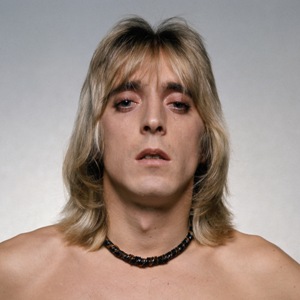
On 6th July 1972 pop music changed for ever when Ziggy Stardust (David Bowie) and the Spiders from Mars performed on 'Top of the Pops'. This performance influenced people as varied as Gary Kemp from Spandau Ballet, Ian Mc Culloch of Echo and the Bunnymen and Boy George of Culture Club. It was seen as a breakthrough performances.

Top of the Pops performance transmitted on 6th July 1972 but recorded the day before. Davis Bowie on left and Mick Ronson on the right.

The Spiders from Mars consisted of Mick Ronson (guitar), Mick (Woody) Woodmansey (drummer) and Trevor Bolder (bassist). All of them were from the Hull area. Prior to the Spiders from Mars there were two other East Yorkshire musicians working with Bowie, John Cambridge and John 'Hutch' Hutchinson. Cambridge and the first three played in a band in Hull called 'The Rats' and had some success before Cambridge ventured to London and started working with Bowie. Cambridge before venturing back to Hull to tempt Mick Ronson down to London to join the 'Hype' that became the Spiders. Ronson was working for the council marking our football pitches. Not long after he called Mick Woodmansey as they needed a drummer. In turn they called for Trevor Boulder to join too.

Trevor Bolder, Mick Woodmansey, David Bowie and Mick Ronson.

Mick Ronson was a proud Yorkshireman and very masculine and so was a great counterpoint to David Bowie's image. He was a brillaint guitarist and has been rated as the fourth best ever at some time. We also arranged the music for several Bowie albums. Mick Woodmansey took over the drums from Tony Visconti and had had is own bands in and around Driffield where he was born. Next came Trevor Bolder who was a good trumpet and cornet player as a youth.

Some of the Spiders were more reticent that others to embrace the new Ziggy fashions and Mick nearly headed back to Hull as he feared that he would lose all his friends if he had to dress like that! Mick Ronson was also credited with arranging on the album.

Mick Ronson died in April 1993 of liver cancer at age 46. Trevor Bolder died in Hull in May 2013 of cancer aged 63. Mick Woodmansey is still drumming and is currently with 3D. 

                        Mick Ronson                                              Mick Woodmansey

Trevor Bolder.

As a fitting tribute to these trail blazing musicians wouldn't it be great to really feature them and their music during our year of culture. At present there is an underused small stage dedicated to Mick Ronson in Queens Park. There could be all sorts of people playing the music at a concert or Sound a Like/Look a Like competitions and also some permanent recognition in the area.

Trevor Bolder and Mick Woodmansey April 2012.


Monday, 29 September 2014

Fact 39. William de la Pole was the first Mayor of Hull.

William de la Pole was born some where between 1290 and 1295 at the trading port of Ravenser. This was on a previous manifestation of Spurn Point and was a very busy place where lots of money was made. It is thought that his Father was a merchant there and he was the middle of three brothers. The eldest Richard, then William and the youngest John. At an early age the two elder brothers established them seleves as traders in their own right. In about 1310 they moved to Hull to continue trading. This may have been due to the erosion of the spit where Ravenser was built and the eventual loss of the town to the sea. William did toy with idea of making Hedon his base as it had a small port and was a safe harbour only about 6 miles from Hull.

By 1317 the brothers had become well established in Hull and both were Deputies of the Royal Chief Butler which meant they were well connected and in 1321 to 1324 they were both Chamberlains of Hull. This meant that they had been selected by royalty to collect the taxes and dues in the town and also for distributing them. This meant that they had great local power too. Much of the monastic lands in Yorkshire were producing wool and soon William began trading in this most valuable of commodities and soon became very wealthy. Du over Gasconye to his connections he began to loan money to King Edward II to finance his war against the French. Loans of £1000 and £1800 were recorded in 1325. He also financed the rebuilding of Hull;'s fortifications. He also loaned money to Edward III for his war against the Scottish. Loans of £6000 and £18000. He was rewarded with the manor of Myton in 1330, and made the firt mayor of Hull from 1331 to 1335 and represented Hull at the various parliaments through the 1330's. For some reason the business partnership with his eldest brother was dissolved in 1331. He was also procuring  supplies and ships for the King and the Scottish War. Hull was well place for this as it was close enough to be accessible to the 'front' but far enough away so as not to be at risk of  capture.


                     King Edward II                                                     King Edward III

The King set up the English Wool Company to maximise the tax that could be made from it to finance the Royal wallet and de la Pole was also involved. In 1338/9 William lent the King a further £10000. As can be imagined this was a massive amount of money at the time and gave him great power over the King. He managed to buy the Seigniory of Holderness for £22650 from the King which caused a little resentment. In 1339 he settled a debt for the King where he had used the Crown as collateral! So it could be said that William de la Pole saved the Crown of England. This is maybe why in the same year he was made Knight Banneret and Baron of the Exchequer. This meant that he was the senior judge in fiancial matters and would have given him even more power.

In 1340 the English Wool Company failed and William and Richard de la Pole and others were arrested. William was imprisoned at Devizes Castle and his lands seized. The charges were dropped in 1344, but before this William had already once more set to fund the Kings wars by the foundation of a new company.  All went well until a brief halt in the warring in 1350 when the charges were resurrected and William had to renounce all claims to the Manor of Burstwick and Holderness. He later felt it expedient to cancel all debts owed by the King  in return for a pardon.

In 1350m he had founded a Hospital in Hull called the Maison Dieu. He also obtained a licence to build a religious house but died before it was completed. His son Michael ensure that it was completed and it  became the Charter House and still exists today. He died in June 1366. It is thought that he is buried in Holy Trinity Church in Hull in the 'de la Pole Tomb'. However it is unlikely that it is William or Richard as details of the clothes etc show that it dates from 15 to 20 years after William, the later to die, passed away. It is thought that it could be another wealthy wool merchant who died in 1390 called Richard de Selby.

Detail of the tomb.


The canopied tomb in situe.

He has a statue on Nelson Street near the Pier. The wording on the plinth reads

 'Sir William de la Pole, Knight Banneret, First Mayor of Hull 1332 to 1335, An eminent and munificent benefactor, Lord of Myton and Holderness, Baron of the Exchequer, Founder of Charter House Hull, Ancestor of  the Noble Family of Suffolk, He died 22 -Jun-1366.'

The statue sculpted by a Hull sculptor William D. Keyworth in 1879 is in the Gothic Revival style that probable wouldn't go down very well today. It was first placed at the junction of Jameson Street and King Edward  Street before being moved to it's current position in 1920. I wonder why it was made so long after the death of the subject? William de la Pole is perhaps remembered best by the older members of the community as the name of the large 73 Acre farm mental hospital on the outskirts of Hull which was opened in 1883. It was actually named after the farm rather than the person but what connection the farm had to the de la Pole's is not known. The asylums chapel is now the crematorium.
Statue of Sir William-de-la-Pole
The W.D Keyworth statue of William de la Pole on Nelson Street.


Sunday, 21 September 2014

Fact.38. Hull saw 2.2 million trans-migrants.

In the late 19th and early 20th Century there was mass migration from Scandinavia, mainly Denmark, Finland. Germany, Norway and Sweden, and Russia. The reasons were many but included economic reasons as depression and failed harvests forced people to look for a better life and pogroms against ethnic groups, especially the Jewish people. Hamburg had been the main port for immigrants leaving for the 'New World' mainly USA, Canada, South Africa and Australia but with the development of the Wilson Shipping line with links with Scandinavian ports and Hull they captured a large part of the trade of steerage passengers. Before 1836 there had been about 1000 a year pass through Hull but following this the pace picked up immensely.

Humber Dock is the enclosed dock in the middle of the photo. 

The passengers were trans-migrants, that is they were passing through Hull on an onward journey to else where. They boarded Wilson's steamers and landed in Hull. From there they were placed on trains and moved on to Glasgow, Liverpool, London and Southampton where they were boarded on ships bound for their final country of destination. When the trade first started the trans-migrants were landed at the Steam Packet Wharf that was in Humber Dock and in Victoria Dock. From there they would have to walk through the town to the station. One of the first ticket agents was Richard Cortis who had offices in the Minerva Hotel that was handy for Humber Dock. This was dangerous as there was a risk of the spread of diseases and the travellers became pry to racketeers. The Hull Sanitary board wanted to stop this so they were kept aboard the ships for up to four days. This led to many complaints from the Sanitary Board to Wilson Line due to the filth conditions aboard. Berths in steerage could be 6' x 6' in tiers of two or three and four people to a berth!

Humber Dock Entrance with the Minerva Hotel on the right.

After 1877 the migrants were usually in Hull only for around 24hrs. Many of the Jewish travellers may have been able to board at Harry Lazurus' Hotel in Postern Gate where they could be fed and looked after before moving onward. A waiting room was built by the North Easter Railway Company, designed by Norbert Prosser, in 1871. Here they could meet the ticket agents and wash and use the toilet. In 1881 the waiting room was doubled in size with a separate waiting room for women and children. The Rail company had a separate platform for the migrants away from the others and accessed directly from the waiting room. Sometimes the trains would be up to 17 carriages. The last four would be for baggage and all pulled by one engine. Due to their length they had precedence on the tracks over others due to their length. Their usual route was via Leeds, Huddersfield and Stalybridge. They often left Hull at around 1100 on Monday and arrived in Liverpool at 1400-1500.

Later the rail tracks were laid to the dock side so the passengers could board direct from the ships. A second platform for immigrants was built at Alexandra dock when that was opened for shipping in after 1881. After 1914 the trans-migration almost ceased due to the WWI.

There are some reminders of these times with the the waiting room still there and several plaques around the city.

Immigrant Waiting Room by Paragon Station built 1871 and extended 1881.

Open platform on the left was right next to the waiting room and was separate from the normal traffic.

Plaque found in the station buildings.


In 2001 a sculpture by Neil Hadlock was donated by Sea Trek Foundation of America. The bronze sculpture depicts a family of immigrants that have just left  their ship and waiting for their train at Paragon Station.

Thursday, 18 September 2014

Fact. 37. Hull's third dock was Junction Dock.

When Humber Dock was built the Act of Parliament allowed for a third dock to be built when trade reached a certain level. A new Act was passed in 1824 and the increased amount of trade was reached in 1825. Construction commenced in 1826.

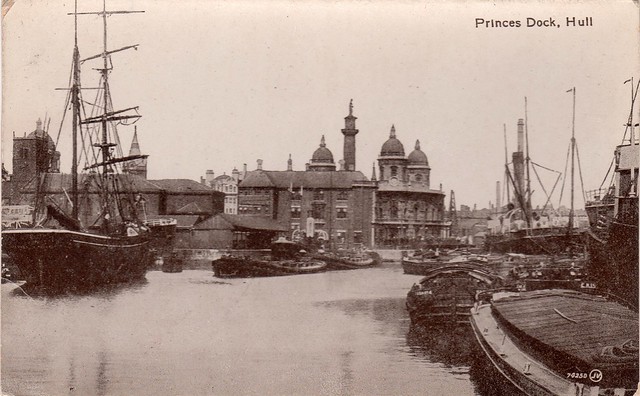
In the centre of the picture is the tall Wilberforce Monument. There are also the three domes of the Dock Offices, now the nautical museum. Beyond the ships on the right is the lock into Queens Dock. The bridge over the lock was called Monument bridge.

Prince's Dock
Taken from the lock through to Humber Dock.
A similar view with Humber keels in the dock.

The construction roughly followed the old walls of the town and so created an island of the Old Town as there were docks on two side and then the River Hull and the Humber. The dock was designed by James Walker and the resident engineer was John Timperley. The cost was £18600. The dock was built 197m long, 124 wide with an 11m wide lock at each end and a movable bridge over each lock.

In 1855 Queen Victoria and Prince Albert visited the city. At this time The Dock was renamed Queens Dock and Junction Dock was altered to Princes Dock. The dock was in use for 139 years until 1969 when it became redundant.

Princes Dock after it was closed in 1969.

In 1991 Princes Quay shopping centre was open to the public. It is built on stilts above the waters of the dock and has three decks and over eighty shop units. Since 1996 the waters surrounding the centre are used to stage and international canoe polo tournament. A local team have been champions three times.

Princes Quay shopping centre.

2013 International Canoe Polo tournament in Hull.

Tuesday, 16 September 2014

Fact.35. Sir Titus Salt assisted Hull's Sailors Orphans .

In 1837 the Sailors Orphan Institute in Waterhouse Lane gave clothing  and offered education to orphans of those lost at sea  and on the River Humber from the city and surroundings.

In 1862 the first orphanage was rented in Castle Row to look after that couldn't be cared for in their own home. Then in 1867 this was supplemented by the purchase of Thanet House in Park Street. The purchase was made possible by a major donation from Sir Titus Salt from Saltaire. He was aware of the perils of the work done by seamen to bring him raw materials of cotton etc and also of exporting his finished goods for sale all over the world. He gave almost the total £4500 that were needed.

File:Hull College, Park Street - geograph.org.uk - 635528.jpg
The original building was the centre part in the above photograph, with the sculpture above. It catered for 100 children. With later extensions either side the numbers went up to 150 and then 220.

The sculpture was also paid for by Sir Titus salt and shows Charity surrounded by orphans and with various nautical themes. Sir Titus Salt's arms are also displayed.

By 1893 the property was becoming not fit for purpose so six acres on Cottingham Road were purchased and by 1897 the orphanage had opened there. They became known as Newland Homes as this was what the plot of land was called. Options on more land were also held.

Then idea was to build 'cottage homes' more similar to a normal home rather than massive institutions with large dormitories. The model village had 12 houses on site along with a school and a sanatorium.

It can be seen that the houses were arranged around a green.

Newland Homes - Francis Reckitt Home, 1902 [C DSSF]
This must be an early photograph as one of the homes is still under construction. The homes were run by a house 'Mother' and assistants. It can be seen that boys and girls were present and they were in uniform.

The twelve homes were named after benefactors, Hannah Pickard, Blackstone Brown, Francis Reckitt, William Richardson, Titus Salt, Dr. Lee and St. Andrews being some of them.

Child care moved towards full adoption and fostering and assistance in their own homes and so the last child left the homes in 2003. The estate had been used by the council to provide residential care for abused children. The site was sold for student accommodation in 2009.

How ever the work continues and the name is now The Sailors' Children's Society and is based at HQS Wellington moored on the Embankment in London. The Patron is HRH The Princess Royal.