Total Pageviews

Sunday, 27 July 2014

Fact 29. Actor John Alderton grew up in Hull.

John Alderton was actually born in Gainsborough in Lincolnshire but moved to Hull with his family and attended Kingston High School. The general public first became aware of his talents when he got a good part in Emergency, Ward 10. Where he played Doctor Moone, which must have been the first medical soap in the UK. He actually married his co-star Jill Brown but it only lasted a few years. Emergency, Ward 10 ran from 1957 to 1967.

John Alderton in Emergency, Ward 10.

He then got the lead part in Please Sir! as Mr Hedges. The series ran from 1968 to 72. He also played the part in the feature film of the same name. At this time he married Pauline Collins
John Alderton in Please Sit!

Later in 1972 he had a new comedy sitcom with Hannah Gordon called My Wife Next door. It ran for 13 episodes and it won him a Jacob's Award. His next success was massive as he appeared as the chauffeur in Upstairs Downstairs with his wife having a part too. The series ran from 1971 to 75 ans several spin offs came from it for him. He and his wife had three children, and a step daughter. He also starred in It shouldn't happen to a vet.  from the book by James Herriot. 

John Alderton in Upstairs Downstairs.

More recently he was the voice of Fireman Sam, the very successful children's cartoon that everybody of a certain age will have got to know by heart as their kids watched it over and over again! He also appeared in the very successful British Film Calendar Girls. He has often worked with his wife

Fireman Sam.

He has recently been in the news for fighting planning application near his home in Hampsted that wanted to knock old homes down and rebuild futuristic building of a much larger size and with a swimming pool underground. He actually won the case.

John Alderton in 2012.

Sunday, 20 July 2014

Fact 28. The most impressive equestrian statue in Britain.

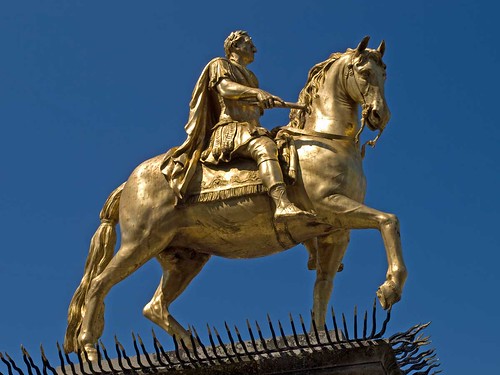
King Billy, as the statue is affectionately know, sits in the centre of the road of Low Gate in Hull. The place was actually where the bear baiting ring was in previous times. The statue is of King William III, William of Orange. Hull was the first large city in Britain to swear their allegiance to the new King when he deposed James II in 1685. This came about as Parliament thought that James was to change the state religion to Catholic and they wanted to remain Protestant. Williams mother, Mary, was daughter of Charles I and then William had married Mary,  his first cousin and eldest surviving daughter of James II, when he was the Duke of York. She was therefore the next in line to the throne after James II. William refused however to be consort to Queen Mary or only as King during her lifetime and threatened to leave the country. Parliament thought it better to have a Protestant King and so it was the connivance of the Houses of Lords and Commons that declared them joint Rulers but William would exercise the regal power for both of them. They were crowned in April 1689. He died in 1702.

William III and Mary II of England, Scotland and Ireland

The statue was paid for by public suscription and cost £785. Today this would be around £150,000. It was designed by a Dutchman Peter Scheemaker in 1734 and sits on a stone pedestal. The Statue is of William in Roman Emperor costume astride a horse. The statue was gilded in 1768. The Inscription reads; " This statue was erected in the year 1734 to the memory of King William Third. Our Great Deliverer."


Statue of King Billy in Low Gate in late 1800's as there are no toilets but the fountain and lamps are there.

The inscription on the plinth with the water fountain below that no longer is working.

In 1880 a plain drinking fountain was added to the plinth below the inscription and in the late 1800's the four lamps were added at the corners of the plinth. These were made by local firm King and Peach.

Details of horse and rider.


In the Victorian era some public conveniences were built below the statue. They were very ornate and had glass cisterns. I always thought they should have had gold fish in.

Gents loos below King Billy's statue.

It was the only piece of public art in Hull to removed to safety for the Second World War and it was taken to Sancton near Market Weighton. It was reinstated in 1948

Date 4-8-1948
The statue being transported back to Low Gate.

There are several myths concerning the statue. The first is that Scheemaker committed suicide when he realised that he had forgotten the stirups but in fact as he is depicted as a Roman they didn't have stirrups at the time. It is also said that when the clock of Holy Trinity strikes midnight King Billy gets off his horse and goes for a drink in the nearby pub. It is also said that when it strikes thirteen the horse also get down for a pint!

Sunday, 13 July 2014

Fact 27. Follow fish for fun. Hull's Fish Trail.

Hull has a unique trail around the 'Old Town' that is marked by forty one sculptures of fish with every letter of the alphabet covered by their initials.

The Fish Trail route.

The Hull Fish Trail was opened in 1992, designed by Gordon Young and was sponsored by Seven Seas that started as the British Cod Liver Oil Producers Company in Hull.  Gordon Young was born in Carlisle and was the curator of the Yorkshire Sculpture Park and a Director of the Welsh Sculpture Trust before becoming a full time artist concentrating on public art in 1984. The Fish Trail was his first large scale work (pardon the pun) but since then he was completed many works including the Eric Morcambe Memorial area in Morcambe in 1999, Listening Stones at GCHQ at Cheltenham in 2004 and the Ring of Steel at MK Stadium Milton Keynes.

Cod cast in bronze and chrome and set in Carrara Marble

The A to Z of fish is represented by a sculpture that when followed takes you round the sights of the Old Town and guide you around the significant areas. Each of the sculptures are life size ranging from tiny anchovy to 10 ft rays. The sculptures also display Gordon Young's sense of humour as there is a Plaice outside the Market Place, and Electic Eel by an electric sub station and a shark outside a bank!

Fish Trail, Kingston upon Hull
Whitebait in Ketley Bricks.

There is now a cost of 40p for the leaflet and 400,000 have taken up the challenge of completing the trail and obtaining a certificate for their completion. Equipment for taking rubbings of the fish can be obtained with the leaflet from the Tourist Information.

A Flying Fish set in low relief York Stone.

Fact 26. The only Corporation owned telephone system in the UK.

After the invention of the telephone the building of systems in the UK was piecemeal. United Telephones (a company owned by Bell and Edison Companies of UK) took over a lot of systems by taking them to court when they used their patents illegally. In 1880 tested the legality of their rights and took over the company and handed the regulation to the Post Office. The PO took 10% of the money taken.

By 1889 the National Telephone Company (NTC) had a near monopoly. By 1898 the Government Select Committee looked into the business and recommended that competition be brought in by offering Local Governments Authorities be able to use rates and borrow money to set up their own systems b y obtaining a licence from the Post Master General. 13 Authorities applied for a licence but only 6 actually set up a telephone system. Brighton, Glasgow, Hull, Portsmouth, Tunbridge Wells, and Swansea. Tunbridge and Swansea sold to NTC by 1907. Glasgow and Brighton were bought by the GPO and Portsmouth sold in 1913 leaving only Hull.

Stowager telephone used in Hull after 1934.

Hull's first licence was granted in 1902 and the first exchange was opened in November in 1904. An offer was made by NTC to buy out Hull's business in 1906 and was only declined by the casting vote of the Chairman. The first exchange was at the former Trippett Street baths.

Photo of plaque
The Second Hull telephone exchange.

By 1914 the second licence was negotiated and part of the approval was that Hull Corporation had to by the equipment for £193,000. That would be about £15 million in today's money.

The first automatic exchange opened in 1922 and the first telephone directory was printed in 1947 and in 1952 they started the first information service (other than the speaking clock) in the UK when they started a Christmas Story for children on dialing a certain number and it is still going strong today. As 1954 was the Golden Jubilee of the first licence the company printed the classified pages on Golden paper that was the fore runner of 'Yellow Pages' today. Hull had the first all digital exchange in the UK in 1989 and in 1999 the Hull City Council 'floated' the company on the Stock Exchange and retained a 44.9% stake in the new company. They sold shares at reduced cost to customers and many made a lot of money as the price rose with the dotcom bubble before it burst.

The cream and green telephone boxes are unique to the city, although they are all cream now. I can not find why that colour was chosen.

The K6 telephone boxes that were designed to commemorate the Silver jubilee of King George V and they went into production 1936.

The modern KX100 near Queens Gardens.

Monday, 30 June 2014

Fact 25. The first British black captain, ever!

Clive Sullivan was born on 9th April 1943 in Splott, Cardiff. He discovered rugby at school and even played for Cardiff schools before a bad leg injury, after which he was advised he may never walk properly, he stopped playing. After a short spell as a motor mechanic he joined the Army in 1961. He did his basic training at Catterick Camp. He wasselected to play for an inter Corps rugby side. He agreed because he thought if he didn't the Army would find out about his injury and be drummed out. He thought that he wouldn't trry very hard and would be dropped. However he couldn't help himself and after scoring a try after running the length of the pitch realised that there were no ill effects. He then decided that he would do his best to push for a rugby career whilst in the Army. After qualifying as a Radio Operator he then volunteered for the Parachute Regiment. After gaining his wings he saw active service in Nicosia in 1964 and was awarded the United Nations Medal after serving with the UN.
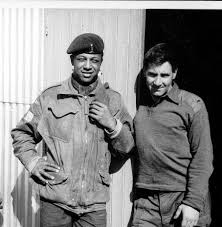
Clive Sullivan when in the Parachute Regiment.

Whilst still in the Army he had a trial with  Bradford Northern Rugby League side. However he didn't get taken up but luck was on his side as one of the touch judges recommended him for a trial with Hull FC. At that trial he scored three tries and was given a contract the next day. His playing at this time was limited not only as he was still serving in the Army but he also had three knee operations, a problem that was to dog his career, and in 1963 he had a near fatal car crash. However he was back playing after only three months. He left the Army in 1964 in time to play the last game of the season for Hull.

Clive Sullivan
Clive Sullivan for Hull FC.

In Hull 1967 he scored 28 tries in 28 games and played for Great Britain against France scoring two tries. In 1968 he scored seven tries in a match against Doncaster. In 1972 he captained Great Britain and became the first black person to captain any British National team in any sport. He also led the squad to victory in the RL World Cup that year and this was the last time GB won the title. He scored in every game and scored perhaps the greatest try ever in the World Cup when running the length of the pitch to bring the game  level to 10-10 against Australia.

Clive Sullivan with the World Cup Trophy in 1972.

Clive Sullivan played 352 times for Hull FC and scored 250 tries making it more of a shock when he signed for Hull Kingston Rovers in 1974. He was in the team that won the Challenge Cup in 1980 when Hull KR beat Hull FC at Wembley 10-5.

Photo: Sullivan named in Greatest 13
Clive Sullivan holds the Challenge Cup aloft following victory 10-5 over Hull FC.

He played 213 times for Hull KR in six seasons and  scored 118 tries. He remains the only player that has ever scored 100 tries for Hull FC and Hull KR. He also won a Championship medal in 1979.

He played 17 times for Great Britain and scored 13 tries and also played 15 times for Wales and scored 7 tries.

He was awarded the MBE for services to Rugby League.

He moved back to Hull FC in 1981 and continued to play and coach. He won a second Challange Cup medal, this time with Hull when he was called up for the Final replay after Hull had drawn 14-14 with Widness. the match was in Leeds and Hull FC triumphed 18-9 in the replay. He played his last game in 1985 and within six months he died of liver cancer on 8th October 1985 at the age of 42. The whole city was shocked by his death. His funeral was held at Holy Trinity Church but there were still thousands that could not get in to pay there respects. 

From the start his biggest asset was his out and out speed. He was said to be like a gazelle from 60 metres out and like a wild bull from 20! He had very strong upper body strength and this meant that unusually for a winger at the time he was very solid in defence too.

The roads that most people visiting Hull will travel on to get there, from the Humber Bridge to the centre of town was called Clive Sullivan Way in honour of Clive Sullivan who was a hero to both sides of the River Hull so uniting the City in sport.

The trophy awarded to the winner of the Derby game between Hull FC and Hull KR is fittingly named the Clive Sullivan Memorial Trophy. He was an adopted son who broke the mould in race in sport and was a true gentleman that brought everybody who met him to love him.


Sunday, 22 June 2014

Fact 24. The first enclosed dock entered from the Humber was opened in 1809.

The Dock, that became Queen's Dock, was a huge success and had become over crowded since it opened in 1778. The size of the ships had continued to grow and this made access via the River Hull even more difficult to gain entry to Queen's Dock. There were several delays, partly because the Hull Dock Company wanted to protect their monopoly as long as possible. How ever by 1802 the pressure resulted in an Act of Parliament being passed with the required permissions etc.

The costs were to be born 50% by the Hull Dock Company and 25% each by Hull Trinity House and Hull Corporation. The work started in 1803 and the spoil excavated from the site was used to reclaim land south of Humber Street. The work was completed in 1809 and was opened for shipping 30th June 1809.

On the right of the postcard can be seen Sammy's Point (where the Deep is now built) that is the entrance to the Old Harbour or River Hull. In the middle is Corporation Pier where the ferries used to operate from. To the left of this can be seen the two jetties that enclosed the tidal basin that led to Humber Dock Lock and the Humber Dock it's self beyond. The photo was obviously taken after 1829 as Junction Dock has been constructed to the north of Humber Dock.

The dock was 279 x 104 metres and the lock was 48 x 13 metres and the water depth in the dock was between 6.4 and 7.4 metres. Out side the lock there was a basin that remained tidal enclosed by a couple of piers. This area was utilised for working the numerous barges and keels that moved cargo around the docks or further afield.

Picture
ENTRANCE TO HUMBER DOCK PHOTO FROM MONZ BROWN
This bridge gives access across the lock area and is still in place.

Picture
Barges being worked by crane in the tidal basin of Humber Dock.

Picture
The photograph looks as though it was taken from roughly where the Light Vessel is now moored and shows the two Associated Humber Line vessels 'Bury' and Melrose Abbey' along with the Humber Pilot Cutter No.2 which was I think  'William Fenton'. The lock would be just astern of the Pilot Cutter.
Innes Collection.

Picture
At some stage two mooring dolphins were placed in the centre of the dock. These were used to increase quay space as vessels could tie up stern to these and use the anchor at the bow and work cargo overside to barges.

The dock finally closed in 1968 and many of the buildings around were also lost. However in 1983 it was re-opened as a marina which still provides a fascinating stroll on a summers evening today.

Almost the same view as the first picture showing Humber Dock as a marina

Sunday, 15 June 2014

Fact 23. Last UK coal fired, steam driven, paddle wheel ferry was on the Humber.

There has been an organised ferry across the Humber from Lincolnshire to near to Hull since 1315 when a grant was given by the King to run such a ferry. It ran to connect the road from London to the road on the north bank to Beverley and York. The tolls charged were passed to the King. The rights to run a ferry were disputed by Barrow and Barton until settled in 1371. There were many private boatmen offering a trip across the estuary. The organised one hadn't really become very efficient by the 17th Century and the lease changed hands often. The toll hadn't increased at all until 1656! In 1796 Hull Corporation bought the lease for £3000. and the Barton Ferry was called the South Ferry.

Another ferry started up in competition from Barrow in 1826. Hull Corporation had banned the market boats that ran from every creek in the estuary to Hull from carrying passengers so they tried to stop this new ferry too. But as they didn't comply with the grant of 1315 by providing ferries to other places in Lincolnshire they had to let it pass. It didn't make money any way and closed in 1851.

A ferry from New Holland was started in 1825 and the first steam ship brought a good regular service of  three sailings a day arrived in 1832 with the 'Magna Charta', and joined by 'Falcon' in 1839. The Royal Mail was moved from using the Barton Ferry to the New Holland and the with the railway arriving the Manchester, Sheffield and Lincolnshire Railway obtained the lease for the New Holland ferry in 1846. The subsequent railway companies kept the lease until British Rail took it on in 1965.
Paddle tugs were required as the water of the crossing was frequently shallow as the mud and sand shifts constantly and the ferries have even been delayed due to have been aground!

Killingholme from 1912. Scrapped at Paull in 1945.

Sister to Killingholme was the Brocklesby of 1912. She was moved to Scotland and scrapped in Holland in 1936.

Frodingham (c. G.Robinson)
Built as a Clyde Ferry and transferred to the Humber and named Frodingham in 1926.

Tattershall Castle (c. G.Robinson)
Built in 1934 the Tattershall Castle was sold in 1975 and is still a floating restaurant on the Thames Embankment.

Wingfield Castle, present day at Hartlepool (c. G.Robinson)
Also built in 1934 and sold in 1975 the Wingfield Castle also became a restaurant but is now in the Hartlepool museum.

Lincoln Castle (c. G.Robinson)
Lincoln Castle was built in 1940 for the route and remained there until 1978 when she was withdrawn due to boiler trouble. She was sold and became a restaurant ashore under the new Humber Bridge and then moved to Grimsby before being broken up. Lincoln Castle was the last coal fired steam paddle tug.

Farringdon was the last ferry on the Humber and was from the Isle of Wight route. It stopped service 1981 when the bridge was opened.

I have often felt that Hull does not make the most of it's water front and turns it's back largely on ships, especially now the fishing fleet has disappeared. I think that it would be wonderful to offer trips on the Humber from a large ferry/passenger vessel. There could be short trips from Hull to the bridge and to Grimsby where there is always sufficient water, and even shorter trips up and down the water front of Hull from Paull Fort to the Humber Bridge. The use of the Pier in Hull would also revitalise the area and be a big draw for the Fruit market area. There are enough commercial operators in the area to make this possible.